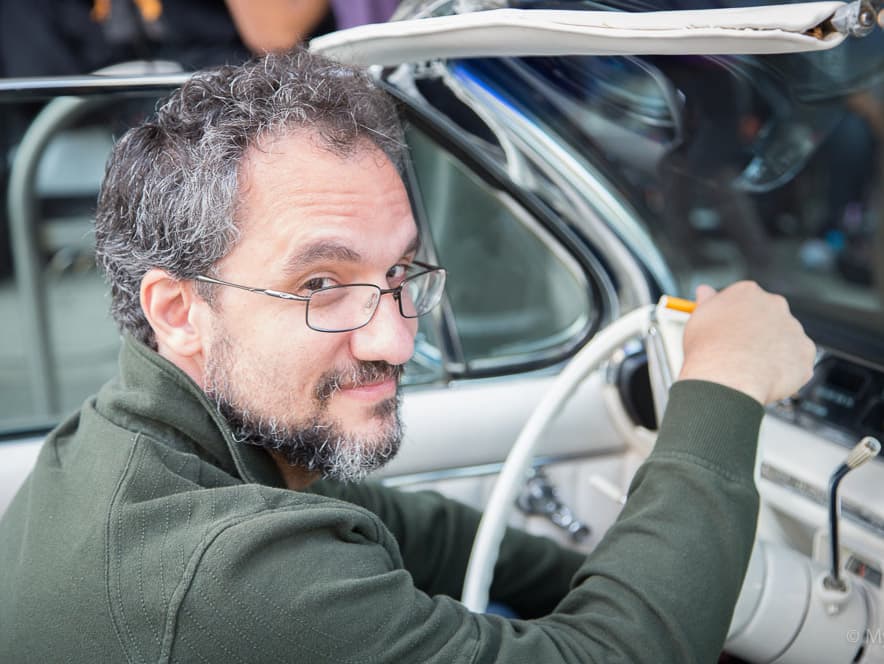

A Note from the Writer/Producer
I arrived in Los Angeles in 2000 with every intention of building a career as a writer, director, and producer in Hollywood. It didn’t take me long to realize I had a problem: I loved telling stories. I loved the strange alchemy that happens when a group of creative people walks into a room with nothing but an idea and somehow creates something that didn’t exist before. I wasn’t nearly as enamored with the business surrounding it.
I also began to understand that I didn’t simply want to make entertainment. Entertainment has genuine value—making people laugh, surprising them, moving them, or simply giving them a couple of hours away from the rest of their lives—but I wanted to do something else at the same time. I wanted to tell stories that might help us understand one another a little better. Stories about the complicated, contradictory people we actually are. Stories that could entertain an audience while quietly asking them to look at something—or someone—from a slightly different angle.
There was another problem I couldn’t have articulated quite as clearly then as I can now: I hadn’t found my voice yet.
So I stepped away.
The plan, to whatever extent there was one, was both idealistic and practical. I wanted to do meaningful work, build businesses, and put myself in a position where, if I eventually returned to theatre and film, I wouldn’t have to wait for someone else’s permission. I wanted the freedom to choose the projects I believed in, the people I wanted to work with, and the stories I thought were worth telling. And somewhere along the way, I needed to figure out what I actually wanted to say.
Several years turned into more than a decade. Kristine and I built businesses. We succeeded at some things and failed spectacularly at others. We met people whose experiences challenged the way we understood the world. And I survived cancer. We survived cancer.
Some experiences strip away the stories we tell ourselves about what we’re worth and how much time we have. Cancer did that for me. For years, I thought I was still searching for my voice. Looking back, maybe I simply needed to accept my voice and appreciate that it won’t be here forever. At some point, you have to stop waiting until you have found exactly the right thing to say and simply say the thing that is yours to say.
Which brings me, somewhat improbably, to Noah Blake’s birthday party.
Kristine and I had never been to Vitello’s. For us, the restaurant had always been associated with one of the most difficult periods in the life of our friend. So when Noah unexpectedly decided to celebrate his birthday there, going felt a little awkward. Maybe even a little weird. But he was our friend, and we wanted to support him. So we went. And we immediately fell in love with the place. Sitting there that night, Kristine and I had virtually the same thought at virtually the same moment: Wouldn’t it be wild to produce a murder mystery starring Noah in the very restaurant his father, Robert Blake, had made infamous through his connection to one of Hollywood’s most notorious murders? We looked at each other. Weeks later, we asked Noah. He thought it was a great idea. Lives are busy and some time passed, but, eventually, Kristine figured out the way to set the wheels in motion. That was all it took.
What began as a wonderfully strange idea at a birthday party gradually became A Killer Night in Studio City. But somewhere during its creation, I realized this strange little murder mystery represented something much larger for me. It was a way back. And not simply back to theatre, but back to what I believe theatre can do.
We are living through one of the greatest revolutions in human communication in history. Almost anyone can now broadcast almost anything to thousands—or millions—of people instantaneously. We have never had more ways to express ourselves. I’m not convinced we’ve ever been worse at actually communicating with one another. Social media has given us extraordinary tools for connection, but it has also trained us to perform for one another, react to one another, categorize one another, and reduce each other to a sentence, a photograph, a post, a political position, or the worst thing they have ever said.
Expression and communication are not the same thing. Neither are expression and art. Art asks something more of us—to shape what we want to express into something another human being can enter. It requires imagination, craft, empathy, and—perhaps most importantly—the willingness to consider an experience other than our own.
That belief sits at the center of DetNY Theatrical Productions. We want to make theatre that entertains. Unapologetically. We want you to laugh. We want to surprise you, transport you somewhere you haven’t been before, and remind you of what human imagination can create. But we also want to make theatre that brings people together. Literally. No matter how sophisticated our screens become or how much of our lives migrate online, there is something technology cannot replicate: Being in a room with other human beings. Breathing the same air. Watching the same story. Laughing together. Becoming quiet together. Feeling the energy in a room change because something has just happened in front of all of us at exactly the same moment.
For thousands of years, human beings have gathered to tell one another stories. I don’t believe technology has made that ritual obsolete. I think it may have made it more necessary than ever. Maybe theatre can help lead us back toward something we are in danger of forgetting: how to be together. How to listen. How to disagree without immediately turning one another into enemies. How to become curious about the person sitting across from us. How to communicate rather than simply express.
That is the journey Kristine and I want to explore through DetNY, and A Killer Night in Studio City is our first step. Underneath the murder, the movie stars, the gossip columns, the cocktails, and all the other pleasures of spending an evening in the Hollywood of 1958 is a story about the danger of believing we understand another person before we know their whole story. It seemed like a pretty good place to begin.
After more than a decade away, I have no idea where this road will ultimately lead. For the first time in my life, I’m not particularly worried about that. I know why I’m on it. And it feels awfully good to be back.